



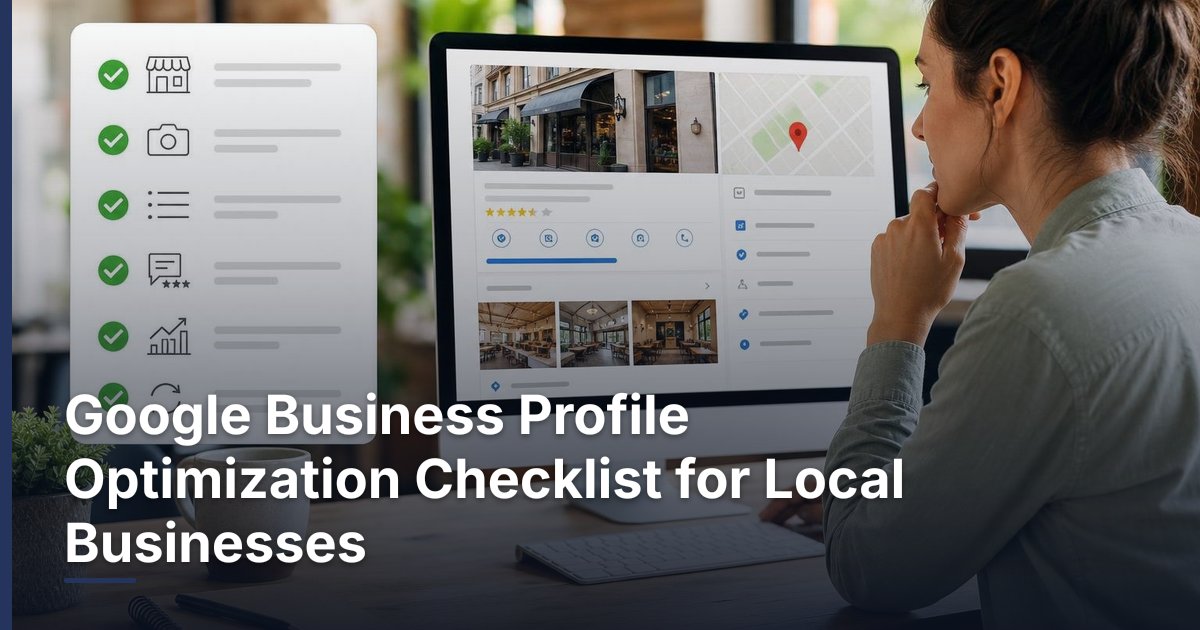
Google Business Profile Optimization Checklist for Local Businesses
Prepared 2026-11-22
A Google Business Profile optimization checklist helps a local business turn an easily neglected listing into a maintained customer touchpoint. Begin with accurate business information, make the profile useful to a buyer, create a clear process for reviews and updates, and measure whether profile activity contributes to qualified inquiries. Verify current Google policies and available features before publishing or changing profile content.
Start with accuracy, ownership, and a source of truth
Optimization begins with operational accuracy. A prospective customer should not encounter an outdated phone number, incorrect hours, old website destination, or a description that no longer reflects the business. Before editing the profile, assemble a simple source-of-truth document with the approved business details your team uses across its website, invoices, directories, social profiles, and customer communications.
Assign clear responsibility
Decide who can update profile information, who supplies operational changes, and who approves sensitive edits. This is especially important when different people handle marketing, front-desk operations, sales, or multiple locations. An ownerless profile can slowly collect inconsistencies even when every individual change seems minor.
- Maintain an approved record for business name, contact details, website destination, hours, service descriptions, and brand language.
- Create an internal trigger for changes such as holiday closures, new services, staff changes, moves, new phone systems, or rebranding.
- Limit editing access to people who understand the business and follow your approval process.
- Keep a short change log with the date, the change made, the reason, and the person responsible.
| Information group | Internal source to check | Review question |
|---|---|---|
| Identity and contact details | Approved business records | Is every customer-facing detail current and consistently written? |
| Hours and availability | Operations calendar | Do published hours reflect regular operations and planned exceptions? |
| Website destination | Current website plan | Does the destination help the visitor take the next relevant step? |
| Services and descriptions | Approved service list | Does the wording accurately describe what the business currently offers? |
| Visual materials | Current brand asset folder | Do images represent the present business, team, products, or work? |
Make the profile useful to a prospective customer
A local listing should help someone make a basic decision: Is this business relevant, credible, reachable, and open when needed? Review every visible element through that lens. The goal is not to add language everywhere; it is to make each available field clear, specific, and consistent with the experience a customer will have after contacting you.
Write for clarity before promotion
Describe services in plain customer language. Explain the type of work you do, who you serve when that is relevant, and what a customer can reasonably expect from the next step. Avoid broad claims that cannot be supported, temporary offers that may become outdated, and wording that conflicts with your website or sales process.
- Use the business description to explain the core offer and the customer problem it addresses.
- Review the primary business category and any additional categories against the services actually provided.
- Check service information for names that customers would recognize and staff can fulfill.
- Use current photos that help customers identify the business, work, products, team, or customer experience.
- Check the website destination on a phone as well as a desktop device, and make sure it matches the profile’s message.
For service-area or appointment-based businesses, internal consistency matters just as much as detail. Do not create expectations your team cannot meet. If the business changes its service area, fulfillment process, or availability, update the profile review checklist alongside the website and customer communications.
Create a responsible customer-interaction process
Customer feedback and questions need an operating process, not improvised replies. Decide who monitors incoming activity, how quickly the team should review it, which questions can receive a standard response, and when an issue should be escalated to an owner or manager. The right response is often helpful and concise rather than defensive or overly promotional.
Review responses before posting
Responses can become public representations of the business. Create a small set of approved response principles that protect customer privacy, avoid discussing sensitive account details, and move complex service issues to an appropriate private channel. Do not offer outcomes, refunds, discounts, or factual explanations that staff are not authorized to provide.
- Set a recurring time for the designated owner to review new feedback and questions.
- Classify the item: positive feedback, routine question, service issue, inaccurate information, or potential escalation.
- Draft a response that acknowledges the customer and gives only information the business can support.
- Escalate situations involving privacy, payment disputes, safety concerns, legal issues, or sensitive customer records.
- Record recurring questions and use them to improve website content, service explanations, or staff training.
Do not treat a review request process as a volume contest. A sustainable approach asks for feedback in a way that fits the actual customer journey and your organization’s policies. Before adopting any solicitation, incentive, filtering, or response practice, check current platform rules and obtain appropriate business or legal guidance where needed.
Measure business value, not just listing activity
A profile can generate visible activity without generating good business. Define what a qualified result looks like for your company before changing profile content or investing more staff time. For one business, that may be a relevant phone inquiry; for another, it may be a completed consultation request, booking, store visit, or ecommerce action.
| Signal to monitor | Business question | Possible follow-up |
|---|---|---|
| Website visits from the profile | Do visitors reach a page that supports their next decision? | Improve the destination page, call to action, or service explanation. |
| Phone or contact inquiries | Are inquiries relevant and manageable for the team? | Review service descriptions, routing, and qualification questions. |
| Direction or location interest | Does location interest align with the customers you serve? | Check location details, hours, and on-site customer information. |
| Customer feedback themes | What are customers praising or finding confusing? | Address recurring operational issues and update customer-facing explanations. |
| Lead outcome notes | Which inquiries become meaningful opportunities? | Use sales feedback to prioritize future profile and website improvements. |
Use a consistent review window when comparing changes. Record what changed, why it changed, and what happened afterward. This does not prove that a single edit caused an outcome, but it gives the business a more disciplined basis for deciding whether to keep, revise, or reverse a change.
Connect the profile to the rest of local marketing
Your profile should support—not replace—a useful website, reliable contact process, and clear local marketing strategy. If profile visitors arrive on a slow, confusing, or mismatched web page, the listing alone cannot resolve that experience. DLR Vortex Solutions can help businesses evaluate how local visibility, website content, lead handling, and reporting fit together.
Set a maintenance rhythm your team can sustain
A manageable routine is more valuable than a large project that is never repeated. Split profile work into quick recurring checks and deeper periodic reviews. The exact schedule should reflect how often your business changes, how much customer activity you receive, and how many people can responsibly contribute.
- Recurring check: review customer feedback, questions, unexpected changes, and urgent operational updates.
- Operational-change check: update the profile whenever hours, contact information, services, locations, or customer processes change.
- Periodic content check: evaluate descriptions, service information, images, website destination, and common customer questions.
- Performance review: discuss inquiry quality and customer feedback with the people who answer calls, manage sales, or deliver the service.
- Access review: confirm that only appropriate team members retain editing access.
Documenting this rhythm makes profile management easier to delegate and more resilient when staff responsibilities change. It also helps prevent a common local marketing problem: accurate information in one channel and outdated information everywhere else.
Use the checklist as a decision tool
The strongest optimization work is often unglamorous: correcting a detail, replacing an obsolete image, clarifying a service, responding appropriately to feedback, or improving the page behind a profile link. Start with accuracy and customer usefulness, then let qualified inquiry data guide larger changes. Avoid making numerous simultaneous edits that make it difficult to understand what improved the customer experience.
If you want a practical review of how your Google Business Profile, website, local SEO, and lead process work together, DLR Vortex Solutions can help you identify priorities and build a manageable plan. Schedule a consultation today!
Frequently asked questions
What should I check first when optimizing a Google Business Profile?
Begin with the information customers rely on to contact and evaluate the business: business name, contact details, website destination, hours, service information, and description. Compare it with approved business records and your website, then assign someone to own future updates.
How often should a local business review its Google Business Profile?
Use a cadence that matches your operations. Review it whenever business details change, monitor customer interactions on a recurring schedule, and perform a deeper periodic review of content, access, and lead quality. Verify current Google functionality and policy requirements before establishing a workflow.
Can I use the same wording from my website on my business profile?
Consistent positioning is useful, but profile content should be concise and customer-focused. Use accurate language that matches the website and the real service experience. Avoid copying outdated promotional claims or adding details that the business cannot support.
Who should manage reviews and customer questions?
Assign a trained owner with a defined escalation path. That person should know which questions they can answer, when to involve operations or management, and how to avoid discussing sensitive customer information in a public response.
What should I measure from a Google Business Profile?
Focus on signals that can be connected to business value, such as relevant contact inquiries, visits to useful website pages, location interest, recurring customer feedback themes, and whether inquiries become qualified opportunities. The best measures depend on your sales process.
Should I make many profile changes at once?
Usually, it is more practical to prioritize the most important accuracy and customer-experience issues first, record what changed, and review results over a consistent period. This gives the team a clearer basis for future decisions, though it does not by itself prove causation.
Do Google Business Profile rules and features change?
Platform rules and available features can change, so this checklist should be treated as an operational framework rather than a substitute for current official guidance. Check current Google documentation before publishing content or using a new feature or solicitation practice.
Related reading
Schedule a consultation today!
Recent Posts


Related Articles
Keyword Research for Small Businesses: How to Choose Search Terms That Support Revenue
Warning: Undefined variable $taxonomy in /home/u765721910/websites/azJno66uV/public_html/wp-content/themes/bw-digiflow/bzotech-templates/posts/grid/grid-style2.php on line 50



Leave a comment