



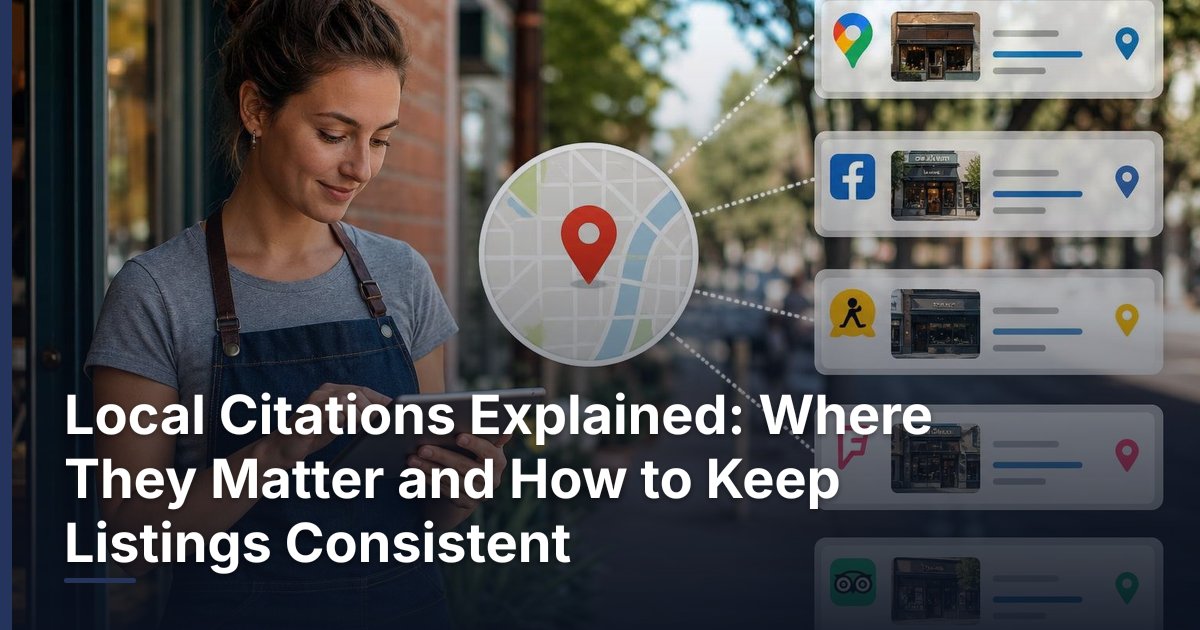
Local Citations Explained: Where They Matter and How to Keep Listings Consistent
Prepared 2026-11-21
Local citations are online references to your business information, such as its name, address, phone number, website, and hours. They matter because people need dependable details when they search, compare options, or try to contact a local company. The priority is not creating the most listings; it is making sure the listings that matter use accurate, consistent information.
What local citations are
A local citation is an online mention of a business. It may be a full profile with contact details, a directory entry, a map result, an association listing, or a reference on another organization’s website. The information can include a business name, street address, phone number, website, hours, services, categories, photos, or a short description.
People often use these mentions to decide whether they have found the right company and how to contact it. That makes accuracy a customer-experience issue before it is an SEO task. A wrong phone number can send an inquiry nowhere. Old hours can create frustration. An outdated address can lead a visitor to the wrong location.
The core details to standardize
- Business name, using the form the company has formally chosen to publish
- Street or mailing address, including suite or unit information when it is part of the customer-facing address
- Primary phone number and any location-specific numbers
- Primary website address and the preferred page for that listing
- Regular and special hours
- Business category, services, service areas, and a concise description
Consistency does not mean every profile must contain identical marketing copy. Different platforms provide different fields and character limits. It means the core identity should not conflict, and descriptions should remain truthful, current, and aligned with the services the business actually offers.
Where local citations matter most
A useful citation plan follows customer behavior. Start with the places where someone may search for a provider, get directions, check hours, compare companies, or confirm that a business is legitimate. Then expand selectively to relevant industry and local sources.
| Listing type | Why review it | Recommended action |
|---|---|---|
| Major search and map profiles | Customers may use them to find contact details, hours, or directions. | Claim or verify the profile and compare every core field with the approved business record. |
| General business directories | They may display business identity and contact information to prospective customers. | Correct inaccurate records and keep only profiles that are credible and relevant. |
| Industry directories | They can help prospects evaluate providers within a particular field. | Use categories, services, and descriptions that accurately reflect the business. |
| Local organizations and associations | They can provide locally relevant references to a business. | Review membership or profile information after operational changes. |
A listing is not automatically valuable simply because it exists. Before investing time, ask whether the platform is credible, whether your potential customers might use it, whether the listing can be kept current, and whether the site is relevant to your service area or industry. A smaller local or industry resource may be more useful to a prospective customer than an unrelated directory with little editorial oversight.
Website mentions also count
Not every citation is a directory profile. A local event sponsor page, supplier directory, chamber membership page, professional association listing, or community resource can also mention a business. These mentions should be evaluated for relevance and accuracy, not treated as a reason to pursue every possible placement.
Why inconsistent listings create business problems
Inconsistent information makes it harder for a customer to know which detail is correct. The problem is especially visible after a move, rebrand, phone-system change, merger, expansion, or a change from one service model to another. A business may update its own website promptly while older profiles continue showing obsolete information.
Small variations are not all equally serious. A difference in capitalization is usually less consequential to a customer than a disconnected phone number, a former address, incorrect hours, or a link to an obsolete website. Triage the issues that can prevent contact or create a poor visit first.
| Issue | Customer risk | Priority response |
|---|---|---|
| Wrong phone number | A prospective customer may be unable to reach the business. | Correct it immediately on the business-controlled site and highest-priority profiles. |
| Old address | A visitor may go to the wrong location or misunderstand the service area. | Update or remove the old location where possible and review duplicate records. |
| Incorrect hours | Customers may arrive or call when the business is unavailable. | Correct regular hours and establish a process for special-hour updates. |
| Old website link | Visitors may reach outdated content or a nonworking page. | Replace the link with the preferred current page. |
| Different business name form | Customers may be uncertain whether listings refer to the same company. | Use the approved published name on new and controlled profiles; document legitimate legacy variations. |
Do not try to hide a legitimate operating change by forcing old information to remain. If the business has moved or rebranded, publish the current information consistently and follow each platform’s available process for updating, closing, merging, or reporting duplicate entries. Keep internal documentation so future team members understand why a change was made.
Build a source of truth for your business information
The most dependable way to manage citations is to create a source-of-truth record before editing profiles. This can be a controlled spreadsheet, a shared document with permissions, or a custom CRM or operations system. The tool matters less than having a named owner, a documented approval process, and one current version.
- Record the approved public business name, address format, phone number, primary website URL, hours, categories, services, service areas, and short description.
- Note details that vary by location, department, or service line so they are not applied incorrectly across every profile.
- List each priority profile, its owner, access method, current status, last review date, and any unresolved issue.
- Decide who can approve changes to public business details and who is responsible for publishing them.
- When a business detail changes, update the source record first, then work through the priority-profile list and document completion.
For businesses with several locations, maintain a separate record for each location while also documenting organization-wide information. Avoid using one location’s phone number, hours, or address for another location unless that is truly how customers are intended to contact the business.
A practical citation audit process
An audit does not need to begin with hundreds of websites. Begin with the business’s own website and the profiles that customers are most likely to see. Search for the business name, current and former phone numbers, current and former addresses, and common variations of the name. Record what you find rather than attempting to fix every item during the discovery stage.
What to record during the audit
- The listing name and platform or website
- The URL or clear identifier for the listing
- The name, address, phone, website, hours, and category shown
- Whether the profile is claimed or controlled by the business
- Whether the record appears current, inaccurate, duplicated, or no longer relevant
- The required action, owner, date requested, and date confirmed
Work from highest customer impact to lowest. First correct the company website and major customer-facing profiles. Next address credible local and industry listings. Finally, decide whether lower-priority entries merit correction, removal, or no action. This order helps a small business use limited time where incorrect information is most likely to affect an inquiry or visit.
Be cautious with automated submission or cleanup services. Before sharing account access or approving broad changes, understand which listings will be affected, which fields will be changed, who retains ownership, and how the work can be verified. Automation can support a documented process; it does not replace review of business-critical details.
Common mistakes to avoid
- Creating profiles before defining the exact information the business wants published.
- Letting multiple people update listings without a shared source of truth.
- Using an old call-tracking, personal, or temporary phone number without a documented plan for continuity.
- Adding categories or services that do not accurately describe the business.
- Ignoring duplicate profiles after a move, location closure, or rebrand.
- Treating one-time cleanup as permanent maintenance.
- Chasing large numbers of irrelevant directories instead of maintaining the listings customers actually use.
The goal is not visual perfection across every platform. It is dependable public information, clear ownership, and a repeatable way to respond when the business changes. If your operations are becoming more complex, DLR Vortex Solutions can help organize website, local visibility, and workflow considerations into a practical plan. Schedule a consultation today!
Conclusion
Local citations are a basic part of how a business presents itself across the web. Keep the information customers rely on accurate, focus on relevant listings, and assign ongoing ownership rather than treating profiles as a one-time setup task. A simple source of truth and a regular review routine can prevent many avoidable listing problems.
Frequently asked questions
What is a local citation?
A local citation is an online mention of a business. It can include core details such as the business name, address, phone number, website, hours, categories, or services. Citations may appear on business profiles, directories, map services, local organizations’ websites, and industry resources.
Is a local citation the same as a backlink?
No. A citation is a mention of a business and may include contact details without linking to the business website. A backlink is a clickable link from another website to your site. A page can contain one, both, or neither.
Which local listings should a small business update first?
Start with the business website and the search, map, and other customer-facing profiles most likely to be used for contact details, hours, directions, or comparisons. Then review credible local and industry-specific listings that are relevant to your audience.
How often should business listings be reviewed?
Review them whenever a public business detail changes, including a move, phone change, rebrand, new location, closure, website change, hours change, or service-area change. A recurring review is also useful for finding outdated records and duplicate profiles.
Do all business listings need identical descriptions?
No. Platforms have different fields and limits. Keep the core business identity consistent, but adapt descriptions to the available format while ensuring they remain current, accurate, and aligned with the services you offer.
What should I do if I find a duplicate listing?
First confirm that it is actually a duplicate and not a separate historical or location-specific record. Document the conflict, determine whether your business controls either profile, and use the relevant platform’s available update, closure, merge, or reporting process. Prioritize duplicates that show wrong contact details or confuse customers.
Related reading
Schedule a consultation today!
Recent Posts


November 20, 2026
Ecommerce Product Page SEO: A Practical Optimization Checklist
Related Articles
Technical SEO Audit Guide: How to Find and Prioritize Website Problems
Warning: Undefined variable $taxonomy in /home/u765721910/websites/azJno66uV/public_html/wp-content/themes/bw-digiflow/bzotech-templates/posts/grid/grid-style2.php on line 50


Leave a comment