

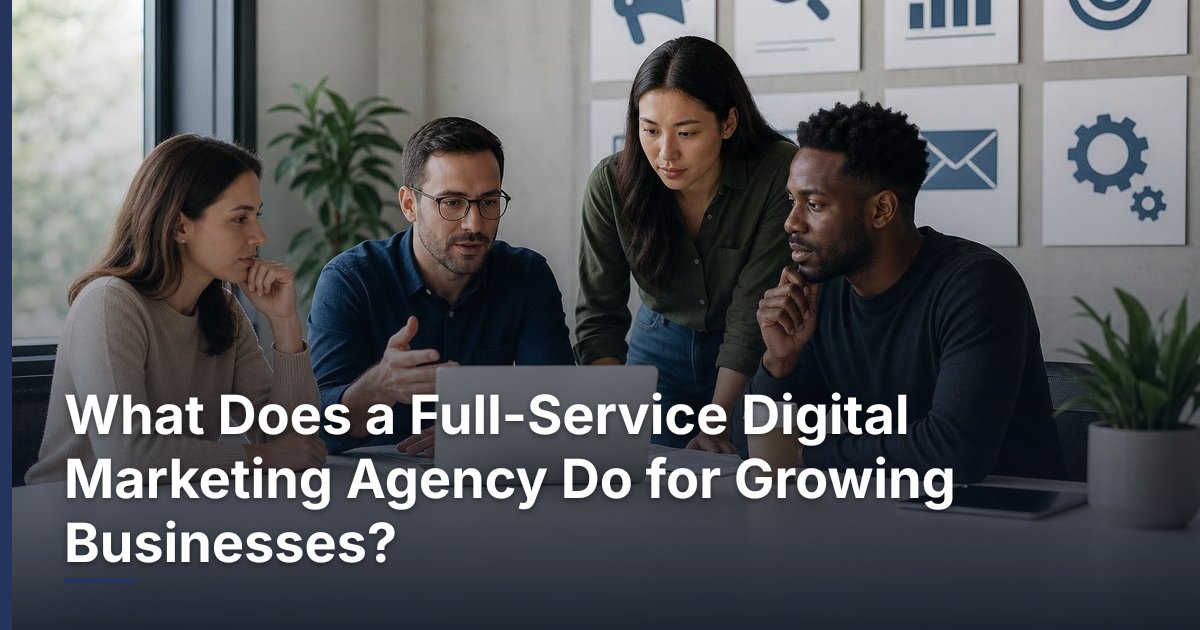
What Does a Full-Service Digital Marketing Agency Do for Growing Businesses?
IN THIS ARTICLE
A full-service digital marketing agency brings together the online work that helps a growing business attract attention, convert interest into inquiries or sales, and support the process after a lead arrives. The exact mix can include website development, SEO, advertising, automation, customer systems, and reporting—but the value comes from connecting those efforts to real business goals.
| Business need | Potential service focus | What to clarify first |
|---|---|---|
| An outdated or unclear website | WordPress website design, redesign, or migration | The primary audience, services, and desired visitor action |
| Limited visibility in search | SEO, local SEO, technical SEO, keyword research, and content strategy | The services, locations, and search topics most relevant to the business |
| A need for faster lead generation | Google Ads, landing pages, and conversion optimization | The offer, budget, response process, and conversion action to measure |
| Inconsistent lead follow-up | Custom CRM, email or SMS automation, and workflow automation | Who owns follow-up and what information the team needs |
| Manual work across disconnected tools | APIs, QuickBooks integrations, and business software integrations | Which systems exchange information and where errors or delays occur |
| A need for practical AI support | AI business assistants and workflow automation | The specific task, approved knowledge sources, and required human review |
The role of a full-service digital marketing agency
A full-service digital marketing agency helps a business plan, build, improve, and connect the digital channels used to attract prospects and support customers. Rather than treating a website, search visibility, advertising, lead follow-up, and internal systems as separate projects, the agency looks at how they work together. For a growing business, this can create a more coordinated path from a person’s first search to a sales conversation or purchase.
Start with business goals and the customer journey
Effective marketing work starts with clear priorities. A business may need more qualified leads, a stronger local presence, a better ecommerce experience, faster lead response, or less manual administrative work. An agency can help define the audience, offers, service areas, buying process, and conversion actions that matter most, such as a phone call, form submission, booked consultation, or online order.
Build or improve the website
For many businesses, the website is the central point where marketing efforts meet. Website design and development can include a new WordPress site, a website redesign, a migration, WooCommerce ecommerce functionality, clearer service pages, and conversion-focused contact paths. The goal is not simply a more attractive site; it is a site that explains the offer clearly and gives visitors a practical next step.
Improve visibility in search
SEO helps a business make its website easier for search engines and prospective customers to understand. Full-service support may include keyword research, content strategy, on-page improvements, local SEO, and technical SEO. These activities can clarify which topics and services a site should cover, improve page structure, and address technical issues that may affect how pages are crawled or experienced. Search results can change, so SEO should be treated as an ongoing process rather than a one-time task.
Use paid campaigns with a clear destination
Google Ads and other digital marketing campaigns can help a business reach people actively looking for relevant products or services. A capable agency connects campaign messaging to the appropriate landing page, offer, and conversion action instead of sending every visitor to a generic homepage. Before expanding spend, businesses should ensure they can respond to inquiries promptly and measure the actions that matter to their sales process.
Connect lead generation, follow-up, and operations
Generating an inquiry is only one part of the process. Growing companies often need a dependable way to route leads, capture customer information, assign follow-up, and reduce repetitive tasks. A full-service agency with technology capabilities may implement a custom CRM, customer portal, email or SMS automation, workflow automation, API connections, QuickBooks integrations, and other business software integrations. The right approach depends on the existing tools, team workflow, and the information that needs to move between systems.
Apply AI carefully to business workflows
Business-focused AI can support tasks such as internal knowledge access, research, content or document drafts, analysis, and employee-specific assistance. It can also be connected to defined workflows where appropriate. However, AI output should be reviewed before it is used for customer-facing, financial, legal, or other important decisions. A useful implementation begins with a specific business process, clear source information, human oversight, and practical rules for how employees should use the tool.
Measure the full path, not just traffic
Traffic alone does not explain whether marketing is supporting the business. Reporting should focus on relevant actions, such as form submissions, calls, booked appointments, purchases, lead quality, and follow-up status when those data points are available. Reviewing this information helps business owners identify where people drop off: search visibility, ad relevance, website messaging, forms, response time, or the sales handoff.
Choose services based on the current bottleneck
A full-service relationship does not require every service at once. If the website is unclear or outdated, start there. If a strong site is not being found, prioritize SEO or local SEO. If leads are arriving but follow-up is inconsistent, focus on a custom CRM and workflow automation. If paid campaigns are planned, confirm that landing pages and measurement are ready first. Prioritizing the biggest constraint can make the work more manageable and easier to evaluate.
A connected partner for growth
DLR Vortex Solutions works with small and growing businesses on websites, SEO, digital marketing, ecommerce, AI automation, custom CRM systems, and business integrations. The most valuable plan is one that fits the company’s goals, existing tools, team capacity, and next practical step. If you want to discuss a connected approach to your website, marketing, and business systems, Schedule a consultation today!
PUT IT INTO PRACTICE
Your next steps
- Define the business outcome you want to improve, such as inquiries, appointments, online orders, or follow-up speed.
- Identify the main customer action your website or campaign should generate.
- Review how leads are captured, assigned, and followed up after they arrive.
- List the software your team uses and note where manual copying, delays, or missing information occur.
- Choose the highest-priority bottleneck before adding more marketing channels.
CONTINUE THE CONVERSATION
Schedule a consultation today!
Recent Posts


Related Articles
How to Build a Digital Marketing Strategy That Generates Qualified Leads
Warning: Undefined variable $taxonomy in /home/u765721910/websites/azJno66uV/public_html/wp-content/themes/bw-digiflow/bzotech-templates/posts/grid/grid-style2.php on line 50


Leave a comment