




Why Your Digital Marketing Is Not Generating Leads—and How to Fix It
Prepared 2026-11-03
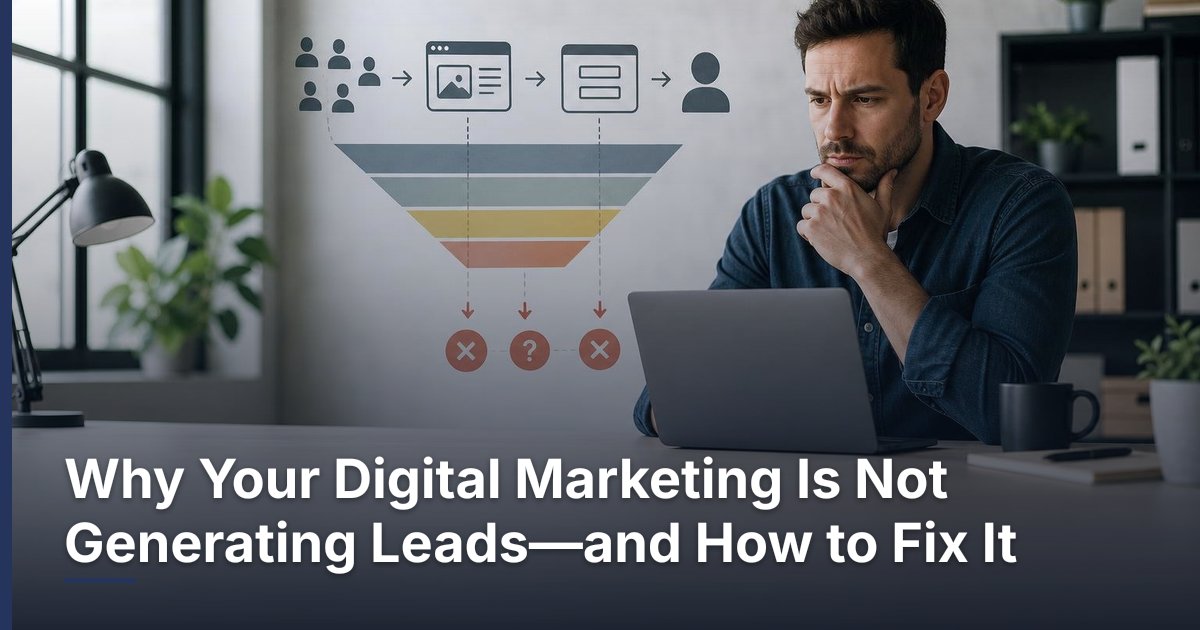
Digital marketing usually fails to generate leads because one or more parts of the customer journey are disconnected: the wrong people arrive, the message does not match their needs, the website makes action difficult, or inquiries are not handled consistently. The fix is not automatically more ads, more posts, or a redesigned homepage. Start by identifying where prospects drop off, then improve the highest-impact gap in a measurable order.
Start with the lead journey, not a channel-by-channel blame game
It is tempting to blame the channel that is easiest to see: search optimization, paid ads, social media, email, or the website itself. But a prospective customer experiences these as one journey. A useful campaign can still underperform when its destination page is vague. A strong website can still sit idle if it is shown to people who are not looking for the service. And qualified inquiries can still disappear when no one owns the next step.
Map the path a prospective customer takes. Identify how they first encounter the business, what question or problem brought them there, what page or conversation they see next, what action they can take, and how the business responds. This turns a broad complaint—“our marketing is not working”—into a set of specific issues that can be tested and improved.
| What you see | Likely area to review | Practical first action |
|---|---|---|
| Website traffic but few inquiries | Offer, page clarity, and call to action | Check whether the page clearly states the audience, problem, service, and next step. |
| Ad clicks with little meaningful engagement | Targeting, message match, and landing page | Compare the ad promise with the headline and content on the destination page. |
| Forms submitted but few sales conversations | Lead handling and qualification | Map who receives each inquiry, what happens next, and where handoffs stop. |
| Leads arrive but their source is unclear | Tracking and system connections | Define the fields and reporting needed to record source, campaign, and outcome. |
| Marketing feels busy but inconsistent | Strategy and priorities | Choose a defined audience, primary offer, and measurable conversion action for each campaign. |
Your message may be attracting the wrong audience—or no clear audience
Broad messaging often sounds safe, but it can leave the right buyer unsure whether a business understands their situation. “We provide quality solutions” does not explain what problem is solved, for whom, or why someone should start a conversation now. The same issue occurs when a campaign tries to reach every industry, company size, and need at once.
For each campaign, define one primary audience and one meaningful problem. A business that provides website redesigns, for example, might speak to companies whose current site is difficult to update, unclear to prospective customers, or disconnected from their lead process. That message is more useful than a generic statement about building websites.
- Describe the buyer in business terms: their role, type of company, current situation, and priority.
- Name the problem in language the buyer is likely to recognize.
- Connect the service to a concrete next step, such as reviewing a website, discussing an integration need, or planning a campaign.
- Keep the promise accurate. Avoid implying a guaranteed volume of leads, ranking position, or outcome.
Check message match from first click to conversion
The wording in an ad, search result, email, referral conversation, or social post should align with the destination page. If someone clicks a message about improving local visibility and lands on a general services page with several unrelated options, they must work harder to understand what to do. A focused page reduces that decision burden by continuing the same conversation.
An unclear offer and weak conversion path can waste qualified traffic
A website is not a brochure alone; it should help a prospective customer decide whether to take the next step. Visitors need quick answers: Is this relevant to my business? What does this company help with? What happens if I contact them? A page that buries those answers beneath general brand language, lengthy menus, or several equal calls to action may lose attention before the visitor reaches the form.
| Page element | What it should clarify | Question it helps answer |
|---|---|---|
| Focused headline | The service or outcome being discussed | Am I in the right place? |
| Audience and problem context | Who the page is intended to help and why | Does this apply to my situation? |
| Service explanation | What the business will help evaluate, build, improve, or connect | What would I be asking for? |
| Primary call to action | The most appropriate next action | What should I do now? |
| Contact path | A straightforward form, phone, scheduling, or other contact option | How do I start the conversation? |
| Expectation setting | What information is useful and what happens after an inquiry | What can I expect next? |
A conversion action does not have to be high pressure. Depending on the service and buying process, it could be a consultation request, a project discussion, a request for an assessment, or a direct call. The important point is that the action fits the visitor’s stage. Asking a first-time visitor to make a large commitment can create friction; offering no obvious action leaves them with no path forward.
Remove avoidable friction
- Use a single primary action on a focused campaign page.
- Ask only for information needed to begin an appropriate conversation.
- Make contact details and primary actions easy to find on smaller screens as well as desktops.
- Test every form and notification path after website changes.
- Avoid sending campaign traffic to a page that forces visitors to search for the relevant service.
More traffic is not the first fix when the funnel is leaking
Increasing visibility can be valuable, but it magnifies both strengths and weaknesses. If the audience, offer, landing page, or follow-up process is unclear, additional clicks may simply create additional waste. Before increasing spend or publishing more content, assess whether the current experience gives a relevant visitor a good reason and easy way to inquire.
This does not mean pausing all marketing activity. It means sequencing improvements. Start with a priority service or offer, build a focused conversion path, confirm that inquiries are received and handled, then use search, paid media, email, content, partnerships, or local marketing to send the right audience into that path. This approach is usually easier to manage than trying to repair every channel at once.
- Choose one service, offer, or customer problem that matters to the business.
- Define the intended audience and the action that counts as a lead for that effort.
- Review the matching page, call to action, form, and confirmation process.
- Confirm who receives the inquiry and how it is recorded and followed up.
- Launch or refine the traffic source that matches the audience’s intent.
- Review inquiry quality and outcomes, then adjust the weakest point before expanding.
Lead follow-up may be the real bottleneck
A submitted form is not the end of marketing; it is the handoff into a business process. Leads can be lost when inquiries go to an unmonitored inbox, are forwarded manually, lack enough context for a response, or are not tracked after the first contact. When this happens, the business may conclude that lead generation failed even though the weak point is lead management.
Document a simple workflow for every inquiry. Specify who is notified, who owns initial contact, what information should be captured, how the lead is qualified, and how the final outcome is recorded. For growing businesses, a custom CRM and workflow automation may help centralize lead details, route tasks, connect systems, and reduce repetitive data entry. The right design depends on the actual sales process, not on adding software for its own sake.
- Ensure a person or role owns the first response for each lead type.
- Use consistent lead statuses so the team can distinguish new, contacted, qualified, inactive, and closed inquiries in a way that fits its process.
- Record the source and campaign when available, without relying on memory later.
- Review lost or stalled opportunities for patterns in fit, messaging, timing, and process.
- Treat automation as support for a clear workflow; it cannot resolve an undefined handoff or an inaccurate offer.
Measure the path to a business conversation, not just activity
Page views, impressions, clicks, and followers can help diagnose visibility and engagement, but they do not independently show whether marketing is producing viable opportunities. Tie reporting to the actions that matter for the business: contact requests, calls, scheduled conversations, qualified opportunities, and outcomes. The exact definitions should reflect the company’s sales process.
A practical measurement plan does not need to be complicated at first. Decide what counts as a lead, identify where that action is recorded, capture the available source information, and routinely compare lead quality with the sales team’s feedback. If source data is fragmented across forms, inboxes, advertising tools, and spreadsheets, connecting those systems may be more valuable than creating another dashboard.
Questions to ask in a recurring review
- Which campaigns or pages initiated relevant inquiries?
- Which inquiries became real sales conversations?
- Where did prospective customers abandon the journey?
- What objections or questions appeared repeatedly?
- Are qualified leads receiving consistent follow-up?
- What one change would make the next stage easier for a prospective customer or internal team member?
Prioritize one accountable improvement plan
The most effective next step is usually not a complete rebuild. Pick the largest, clearest constraint in the current journey and assign an owner. That might be refining a service page, separating a broad campaign into more focused offers, repairing form routing, defining lead stages, or connecting marketing and sales data. Make the change, observe the resulting lead quality and workflow, and use what you learn to guide the next improvement.
DLR Vortex Solutions helps small and growing businesses connect websites, digital marketing, automation, and business systems around practical lead-generation processes. If you need help identifying where your customer journey is breaking down and planning a focused improvement, schedule a consultation today!
Frequently asked questions
Why is my website getting traffic but no leads?
Traffic alone does not show whether visitors are the right audience or whether the page answers their needs. Review the source of the traffic, the match between the visitor’s intent and page message, the clarity of the offer, the primary call to action, and whether the contact path works as intended.
Should I spend more on ads if my digital marketing is not generating leads?
Not until you understand the current weak point. More paid traffic can be useful when the audience, message, landing page, and follow-up process are working together. If those pieces are unclear, first improve the conversion path and lead-handling process so additional traffic has a stronger chance to produce useful inquiries.
What should count as a lead?
A lead should be defined by the business’s actual sales process. It may be a contact request, call, scheduled consultation, or another inquiry that contains enough information for appropriate follow-up. Separate raw inquiries from qualified opportunities so reporting reflects both marketing response and business fit.
How can I tell whether the problem is marketing or sales follow-up?
Map every handoff after an inquiry arrives. Check whether notifications are received, whether a person owns first contact, whether the inquiry is recorded, and whether the final status is captured. If submitted leads are not consistently contacted or tracked, the bottleneck may be in the follow-up process rather than the traffic source.
Do I need a custom CRM to improve lead generation?
Not every business needs a custom CRM immediately. Start with a documented process for capturing, routing, and tracking leads. A custom CRM can become useful when existing tools do not fit the workflow, important data is scattered, or manual handoffs create avoidable gaps.
What is the first improvement I should make?
Choose the most important service or offer and inspect its complete path: intended audience, campaign message, destination page, conversion action, inquiry routing, and follow-up. Improve the clearest point of friction first rather than changing every marketing channel at once.
Related reading
Schedule a consultation today!
Recent Posts


November 20, 2026
Ecommerce Product Page SEO: A Practical Optimization Checklist
Related Articles
Local Citations Explained: Where They Matter and How to Keep Listings Consistent
Warning: Undefined variable $taxonomy in /home/u765721910/websites/azJno66uV/public_html/wp-content/themes/bw-digiflow/bzotech-templates/posts/grid/grid-style2.php on line 50


Leave a comment