


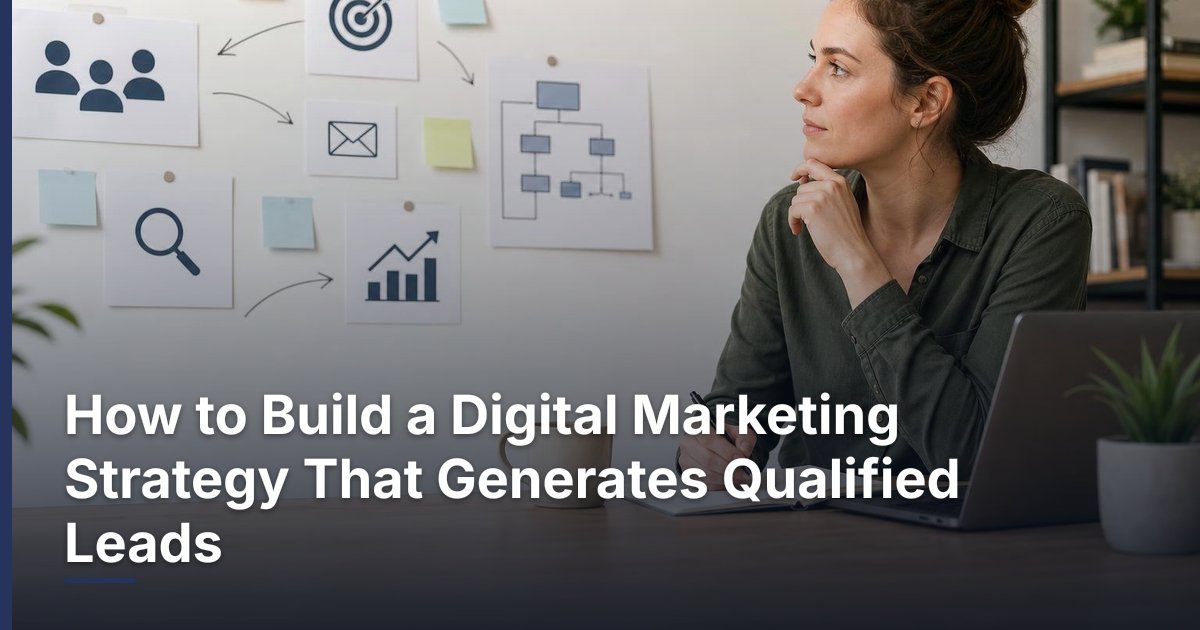
How to Build a Digital Marketing Strategy That Generates Qualified Leads
IN THIS ARTICLE
A qualified-lead strategy is more than running ads, publishing social posts, or adding a contact form to a website. It is a coordinated plan for reaching the right people, answering their questions, guiding them to a meaningful next step, and following up consistently. This guide explains how to build a digital marketing strategy for qualified leads without treating every click or inquiry as equal.
| Component | Primary role | Practical consideration |
|---|---|---|
| Audience and qualification criteria | Define the prospects the business wants to pursue | Marketing and sales should use the same criteria. |
| Website service pages and landing pages | Explain the offer and guide visitors to a relevant next step | Match the page message to the campaign or search query. |
| SEO and paid search | Reach people who are researching or searching for solutions | Use clear targeting and send visitors to relevant pages. |
| Lead capture and follow-up workflow | Route inquiries and support consistent response | Document ownership, required details, and how outcomes are recorded. |
| Reporting and review | Identify where suitable prospects progress or drop off | Assess lead quality, not just inquiry volume. |
Start with a clear definition of a qualified lead
A digital marketing strategy for qualified leads begins with clarity about who the business wants to reach and what makes an inquiry worth pursuing. A qualified lead is not simply a form submission, phone call, or email address. It is a prospective customer whose needs, budget range, decision-making role, location or service fit, and timing align with what the business offers. The exact criteria will differ by business, but the sales and marketing teams should use the same definition.
Set goals that connect marketing to sales activity
Choose goals that reflect meaningful progress toward revenue rather than focusing only on traffic or social engagement. For example, a service business may track consultation requests from target industries, while an ecommerce business may focus on repeatable purchase paths and email subscribers who show product interest. Document the desired action, the audience segment, the offer or message, and how the team will record the source of each inquiry. This creates a practical foundation for evaluating which marketing efforts bring the right opportunities.
Map your customer journey and search intent
People at different stages need different information. Someone researching a problem may need an educational guide, while someone comparing providers may need service details, examples of the process, or a consultation option. Build pages and campaigns around those needs instead of sending every visitor to the same generic page. Search engine optimization, paid advertising, email, and social content work better when each message leads to a relevant next step.
Build conversion-ready website pages
Your website should make it easy for a suitable prospect to understand what you do, who you serve, and how to start a conversation. Give each key service a focused page with a plain-language explanation, relevant questions it solves, and a clear next action. Keep contact forms purposeful: ask for the details needed to route and prepare for the inquiry, but avoid creating unnecessary friction. Fast, usable pages and clear navigation also help visitors move from research to action.
Choose channels based on fit, not popularity
A strong channel mix follows buyer behavior and the company’s capacity to respond. SEO can support people actively searching for solutions. Google Ads can place an offer in front of high-intent searches when the campaign, landing page, and follow-up process are aligned. Email can nurture contacts who are not ready to buy. Local SEO may be relevant when customers search for nearby providers. Use a small number of well-supported channels first, then expand after the business has a reliable way to measure inquiries and follow up.
Create offers that help prospects take the next step
An offer should match the visitor’s level of readiness. A decision-ready prospect may want a consultation, quote request, or product demonstration. An earlier-stage prospect may prefer a checklist, guide, webinar, or diagnostic conversation. The goal is not to collect contact information at any cost; it is to exchange something useful for permission to continue a relevant conversation. Be specific about what happens after someone submits a form or schedules a call.
Connect lead capture, routing, and follow-up
Lead generation can break down after a form is submitted. Define who receives each lead, what information they need, when they should respond, and how the outcome will be recorded. A custom CRM, email or SMS automation, and business-system integrations can reduce manual handoffs when they are designed around an established process. Automation should support timely, consistent follow-up while leaving room for a real person to handle complex questions and high-value conversations.
Measure lead quality and improve the system
Review performance across the full path: channel, landing page, conversion action, follow-up, sales conversation, and outcome. Look for patterns such as campaigns that produce many inquiries but few suitable conversations, or service pages that attract the wrong type of request. Update targeting, messaging, page content, qualification questions, or follow-up workflows based on what the team learns. Continuous improvement is more useful than making major changes based on a small amount of activity.
A practical strategy is an operating system, not a one-time campaign
The most useful digital marketing strategy connects audience research, content, website experience, lead capture, and follow-up into one manageable process. Start with a defined audience and a clear conversion path, then build measurement around the outcomes that matter to the business. DLR Vortex Solutions can help small and growing businesses align websites, SEO, paid marketing, automation, and integrations around a practical lead-generation process. If you want help identifying the gaps in your current approach and planning the next steps, schedule a consultation today!
PUT IT INTO PRACTICE
Your next steps
- Document your ideal customer and the criteria that make an inquiry a good fit.
- Choose one primary conversion action for each key service, campaign, or audience segment.
- Review whether each landing page answers the visitor’s likely question and presents a relevant next step.
- Assign ownership for new inquiries and establish a process for recording outcomes.
- Review lead sources and qualification outcomes regularly before expanding to additional channels.
CONTINUE THE CONVERSATION
Schedule a consultation today!
Recent Posts


Related Articles
SEO vs. Google Ads: Which Strategy Is Right for Your Business?
Warning: Undefined variable $taxonomy in /home/u765721910/websites/azJno66uV/public_html/wp-content/themes/bw-digiflow/bzotech-templates/posts/grid/grid-style2.php on line 50

Leave a comment