


Small Business Marketing Funnel: How to Attract, Nurture, and Convert More Leads
Prepared 2026-10-27
A small business marketing funnel gives prospects a clearer route from discovering your business to taking a meaningful next step. The most useful funnels are not complicated diagrams: they align the questions buyers ask with the pages, messages, offers, and follow-up your team can consistently deliver.
What a small business marketing funnel does
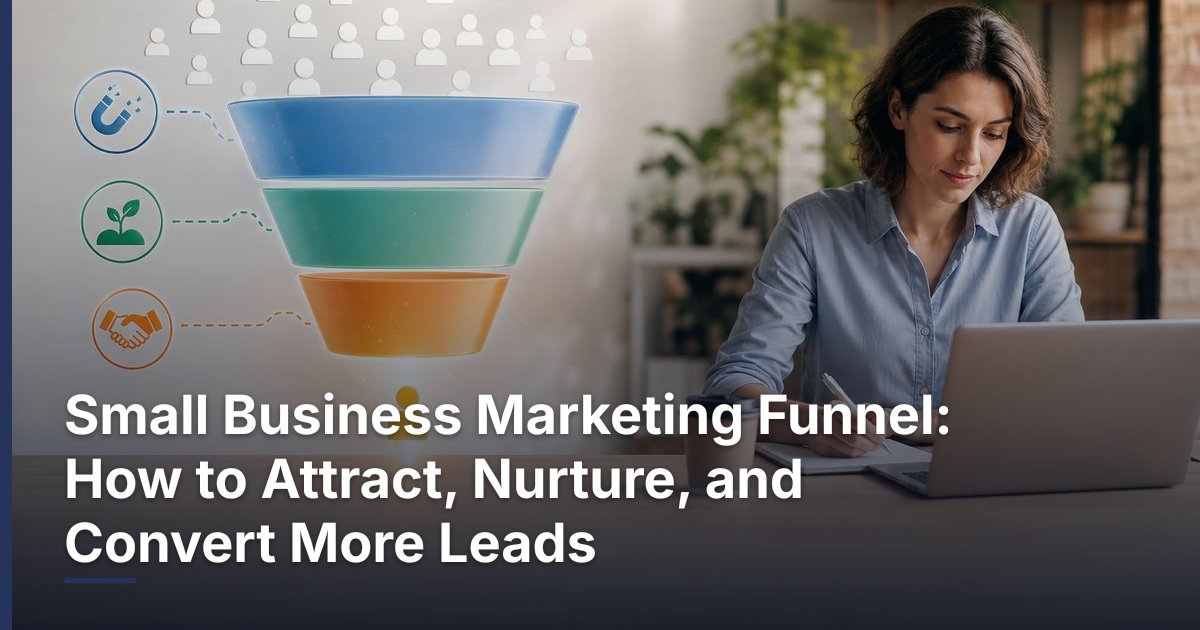
A marketing funnel is a planning tool for the path a potential customer may take from first contact to a business outcome. That outcome could be an ecommerce order, a service inquiry, an estimate request, a booked discovery call, or another action that begins a sales process. It helps a business decide what to say, where to say it, and what should happen after someone responds.
The funnel is not always linear. A prospect may visit several pages, return after an email, ask a colleague for a recommendation, or contact your team before consuming much content. The value of the model is not predicting every action. It is creating a reliable experience for the common questions and decisions that lead toward a sale.
| Funnel stage | Buyer need | Useful business response |
|---|---|---|
| Attract | Recognize a problem or opportunity | Publish relevant pages, educational content, local visibility assets, or targeted campaigns that lead to a clear next step. |
| Nurture | Compare approaches and reduce uncertainty | Provide helpful explanations, examples, email follow-up, and answers to common objections. |
| Convert | Choose a provider, product, or conversation | Use focused service or product pages, clear contact options, and a reliable process for responding to inquiries. |
| Retain and refer | Get continuing value after the initial decision | Support customers, request feedback at an appropriate time, and identify relevant follow-on needs. |
Attract the right people before trying to scale traffic
Attraction begins with relevance. Rather than pursuing attention from anyone who might click, identify the audience most likely to benefit from your offer and the problem that brings them to search, social media, referrals, or advertising. A clear audience and problem statement makes channel selection and content decisions much easier.
Match the entry point to the search or need
Someone searching for an urgent solution generally needs a direct service or product page. Someone trying to understand an unfamiliar issue may need a guide, checklist, comparison, or short explainer first. Sending both audiences to a generic home page can make the next action unclear.
- Create pages around specific services, products, locations, or customer problems where that structure reflects your actual business.
- Use plain-language headlines that explain who the offer is for and what the visitor can do next.
- Keep campaign messages aligned with the landing page. An ad or social post should not promise a different experience than the destination page provides.
- Choose a single primary action for high-intent pages, while still making essential contact details easy to find.
- Consider local search visibility, educational content, referrals, email, paid campaigns, and partnerships as potential entry points based on your audience and capacity.
Traffic quality matters more than traffic volume when a team has limited time. A smaller group of visitors with a clear reason to engage can be more manageable and more useful than broad attention with no connection to the offer.
Nurture interest by reducing uncertainty
Many prospects are not ready to buy during their first visit. They may be comparing options, checking whether your business understands their situation, gathering input from other decision-makers, or deciding whether the timing is right. Nurturing gives them useful reasons to continue the conversation without pressuring them into a commitment they are not prepared to make.
For a service business, useful nurture content may explain the process, scope, typical decision points, and what a productive first conversation looks like. For ecommerce, it may include clear product details, comparison guidance, shipping and return information, or answers to pre-purchase questions. The goal is clarity, not volume for its own sake.
| Prospect situation | Appropriate next step | Helpful follow-up |
|---|---|---|
| Learning about a problem | Read a focused guide or view an explainer | Offer related educational content that answers the next likely question. |
| Comparing solutions | Review service details, product information, or a comparison resource | Share decision-focused information and invite specific questions. |
| Considering your business | Request an estimate, schedule a conversation, or begin a purchase | Confirm the request, set expectations, and route it to the appropriate person. |
| Existing customer with a new need | Explore a relevant service, product, or support option | Use context from the existing relationship without assuming the customer wants every offer. |
Use lead capture with a clear value exchange
A form, newsletter sign-up, downloadable resource, or appointment request should make sense in context. Ask only for information needed for the next step. If a visitor is early in research, a lower-commitment option may be more appropriate than a detailed sales form. If the visitor is ready to discuss a project, a form that captures key project details can help the business respond more usefully.
Automation can support timely acknowledgments, lead routing, reminders, and relevant follow-up sequences. It should not replace judgment. Review automated messages for accuracy, tone, timing, and whether they still reflect the current offer. When AI is used to assist with content or communication workflows, keep human review in the process for customer-facing material and important business decisions.
Convert leads with a simple, dependable handoff
Conversion is not only a button click. For many small businesses, it includes the operational handoff after a form submission, call, order, or meeting request. A strong landing page cannot compensate for an unclear ownership process or inconsistent follow-up. Decide who receives each type of inquiry, what information they need, and what the prospect should expect next.
- Define the primary conversion for each important page or campaign, such as a call, form submission, meeting request, checkout, or quote request.
- Make the action easy to understand. Use specific language that describes what happens when the visitor clicks or submits.
- Route inquiries to an owner and record the source, request type, and relevant context in a system your team will actually use.
- Set an internal response process appropriate to the inquiry type and your available capacity.
- Review lost, unqualified, and delayed opportunities for recurring issues in messaging, targeting, intake questions, or follow-up.
A custom CRM or connected business system can be useful when leads arrive through multiple channels or require several follow-up steps. The best setup is usually the simplest one that gives the team visibility into the next action. Start with the workflow you need, then select or configure technology to support it; do not assume a new platform will fix an undefined process.
Measure the funnel without getting lost in reports
Measurement should answer operational questions: Which channels produce inquiries? Which pages lead to meaningful actions? Where do qualified prospects stall? Which inquiry types become viable opportunities? The exact metrics depend on the business model, but each metric should inform a decision rather than exist only for reporting.
- Track the conversion actions that matter to the business, not only page views or clicks.
- Separate raw inquiries from leads that meet your internal definition of a fit.
- Use consistent campaign naming and lead-source fields where practical so results can be interpreted later.
- Review website experience, message match, form friction, routing, and follow-up before concluding that a channel does not work.
- Protect customer information and ensure any analytics, forms, CRM, and automation tools are configured appropriately for your business and obligations.
Avoid changing every part of the funnel at once. If a key page produces visits but few inquiries, test its clarity, call to action, offer alignment, or form experience. If inquiries arrive but rarely progress, examine qualification, response handling, sales messaging, and whether the marketing promise matches the actual service. Incremental changes make it easier to learn what helped.
Common funnel mistakes and a practical starting plan
A common mistake is treating the funnel as a collection of tools rather than a customer experience. Another is asking every visitor for a high-commitment action before earning enough trust or providing enough context. Businesses also lose momentum when marketing generates inquiries that no one owns, or when the website and sales conversation describe different offers.
Start with one journey that matters
You do not need a complex multi-channel system to begin. Choose one core service or product, one primary audience, and one conversion action. Map the questions a prospective customer asks from first awareness through decision. Then identify the pages, content, contact options, follow-up messages, and internal handoffs that support that path.
For example, a hypothetical local service business might create a focused service page for high-intent searches, publish a short guide for people evaluating the problem, invite ready visitors to request a consultation, and use a defined intake process to route those inquiries. The business can then review where prospects stop moving forward and improve that specific point before expanding the program.
A well-designed funnel should make marketing more accountable and the buying experience easier to navigate. If you want help connecting your website, lead generation, automation, and follow-up into a practical process, DLR Vortex Solutions can help you assess the path that fits your business. Schedule a consultation today!
Frequently asked questions
What are the main stages of a small business marketing funnel?
A practical model includes attracting relevant prospects, nurturing their interest, converting ready prospects into a meaningful business action, and supporting retention or referral after the initial decision. The exact stages can vary by business, but each should reflect a real customer question and a realistic next step.
Does every small business need a complex marketing funnel?
No. A simple funnel built around one audience, one offer, and one primary conversion action is often a better starting point than a complicated system your team cannot maintain. Add channels, automation, and reporting only when they support a defined workflow.
What is the difference between lead generation and lead nurturing?
Lead generation creates opportunities for prospective customers to identify themselves through actions such as submitting a form, calling, requesting information, or making a purchase. Lead nurturing helps interested people move toward a decision by providing relevant information and follow-up before or between sales conversations.
How should a small business choose a call to action?
Match the call to action to visitor readiness and the commitment required. Early-stage visitors may respond better to an educational resource, while people evaluating a specific service may be ready to request an estimate or schedule a conversation. The action should clearly explain what happens next.
What should be tracked in a marketing funnel?
Track the actions that represent real progress for your business, such as inquiries, calls, meeting requests, purchases, qualified leads, and opportunities. Use those signals to identify bottlenecks in traffic quality, page experience, lead intake, or follow-up rather than relying only on visits and clicks.
Can automation improve a marketing funnel?
Automation can help acknowledge inquiries, route leads, send reminders, organize information, and support repeatable follow-up. It works best when the underlying customer journey, ownership, and messaging are already clear. Customer-facing automated content should be reviewed for accuracy and relevance.
Related reading
Schedule a consultation today!
Recent Posts


November 20, 2026
Ecommerce Product Page SEO: A Practical Optimization Checklist

November 19, 2026
How to Reduce Cart Abandonment on a WooCommerce Store
Related Articles
Technical SEO Audit Guide: How to Find and Prioritize Website Problems
Warning: Undefined variable $taxonomy in /home/u765721910/websites/azJno66uV/public_html/wp-content/themes/bw-digiflow/bzotech-templates/posts/grid/grid-style2.php on line 50


Leave a comment