



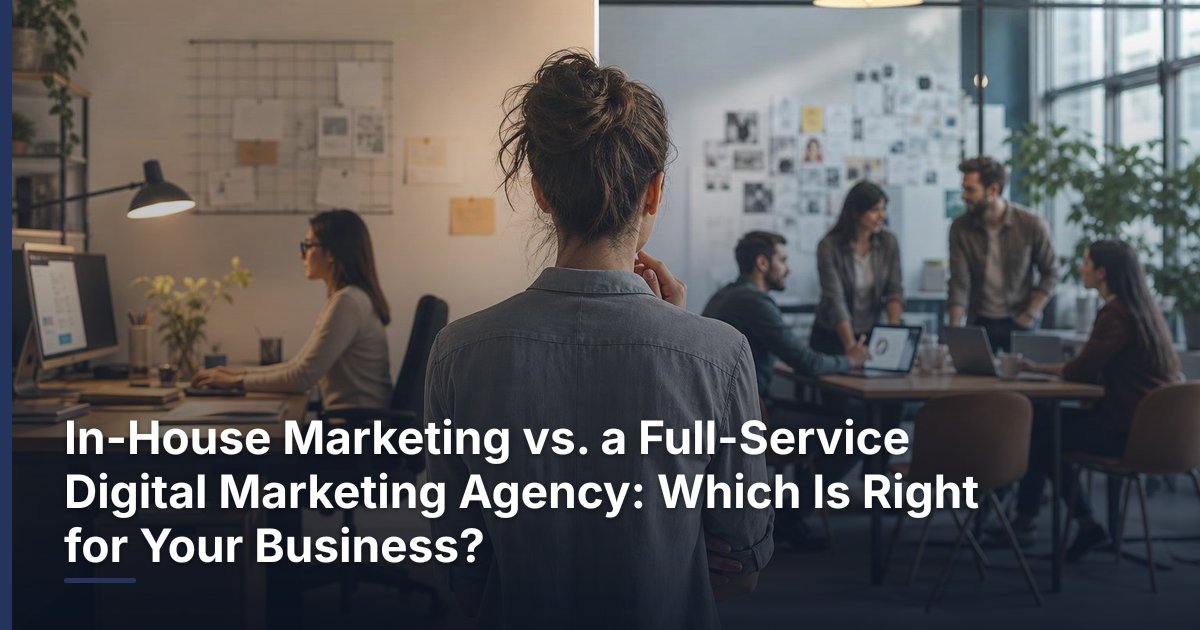
In-House Marketing vs. a Full-Service Digital Marketing Agency: Which Is Right for Your Business?
Prepared 2026-10-20
Choosing between in-house marketing and a full-service digital marketing agency is not a simple question of control versus outsourcing. The better option depends on the marketing work your business actually needs, the skills already on your team, your ability to manage the work, and how quickly priorities may change. For many small and growing businesses, a hybrid arrangement is the most practical path: keep business knowledge and decision-making close to home while using outside specialists for defined initiatives or capability gaps.
Compare the models before comparing costs
There is no published pricing evidence in the supplied materials, so this comparison does not present agency rates, salary ranges, or cost savings claims. Instead, use a like-for-like scope comparison. First decide what marketing is responsible for, then identify the people, skills, tools, and management needed to deliver that work.
| Decision area | In-house team | Full-service agency | Hybrid model |
|---|---|---|---|
| Daily brand and sales context | A dedicated employee can stay close to internal conversations and priorities. | The business must share context, feedback, and access consistently. | An internal owner supplies context while outside specialists support defined work. |
| Range of skills needed | May require multiple hires or outside help when needs span several disciplines. | Can bring a coordinated scope that covers more than one discipline. | Internal leadership can be paired with specialist support where gaps exist. |
| Hiring and management | The business recruits, onboards, develops, and manages employees. | The business selects a partner, defines scope, and manages the relationship. | The business manages both internal ownership and external coordination. |
| Cost comparison | Evaluate the full internal scope, not only salary. | Evaluate the written scope, exclusions, and any work outside the agreement. | Separate internal ownership costs from the outside work being purchased. |
| Best starting question | Do we have enough focused, ongoing work for a dedicated role? | Do we need several capabilities without building each one internally? | Which responsibilities must remain inside, and which can be specialized externally? |
A decision becomes clearer when the alternatives solve the same problem. For example, compare a defined annual marketing plan with the people and work required to carry it out. Do not compare one internal generalist against an agency scope that includes strategy, creative work, website support, search optimization, paid advertising management, reporting, and automation support unless those are genuinely equivalent.
When an in-house marketing team may fit
In-house marketing may fit when your business has a consistent volume of ongoing marketing work and needs someone closely involved in daily operations. An embedded marketer can gather product updates, hear customer questions, coordinate with sales, and protect brand consistency as part of normal business activity.
Signs internal ownership matters most
- Marketing depends on frequent input from leadership, sales, operations, or subject-matter experts.
- Your offer, product catalog, campaigns, or customer communications change often.
- You have enough recurring work to keep a dedicated role focused on meaningful priorities.
- A manager can set direction, remove blockers, review work, and make timely decisions.
- The business wants to build marketing knowledge and processes as an internal capability.
Hiring is not the same as creating a marketing function. A new employee still needs a plan, priorities, access to accurate information, appropriate tools, and clear ownership over decisions. They may also need external help for specialized work that does not justify a permanent role, such as a website rebuild, technical search work, complex tracking, paid-media setup, integration work, or a focused conversion project.
Questions to ask before hiring
- What work will this person own in the first several months?
- Which activities require specialized skills beyond the role’s core responsibilities?
- Who will set priorities and approve campaigns, content, website changes, and budget decisions?
- What customer, sales, and performance information will the person be able to access?
- If leads increase, who follows up and how will the business assess lead quality?
When a full-service digital marketing agency may fit
A full-service digital marketing agency may fit when a business needs coordinated support across several marketing disciplines but does not want to recruit and manage a separate internal specialist for each need. The value of this approach depends on a precise scope, a capable agency team, and a client team that can provide direction and decisions.
Situations where outside support can be practical
- You need to build or improve a website while also addressing visibility, content, lead capture, and measurement.
- A small internal team needs help executing a strategy rather than adding several permanent roles at once.
- You have a defined initiative, such as a website redesign, ecommerce improvement, local search project, campaign launch, CRM project, or workflow automation effort.
- Your business needs specialist input but wants one accountable partner to coordinate the agreed scope.
- Leadership can provide prompt feedback, designate an internal owner, and make decisions without lengthy approval delays.
Agency support is not hands-off. An outside team cannot reliably supply your business priorities, accurate service details, customer insight, sales feedback, approval authority, or access to the systems needed for the work. Treat the relationship as a working operating model: the agency brings agreed capabilities and execution; your business brings direction, subject expertise, access, and decisions.
What to clarify in an agency scope
| Area | Question to resolve | Why it matters |
|---|---|---|
| Business objective | Which business outcome should this work support? | Activities are easier to prioritize when the intended result is clear. |
| Deliverables | What work will be delivered and at what cadence? | A deliverable-based scope reduces assumptions about what is included. |
| Responsibilities | What will the business provide, approve, or own? | Marketing work can stall when access, content, or decisions are unclear. |
| Measurement | What will be reported and how will the business use it? | Reporting should inform decisions rather than create activity without context. |
| Exclusions and changes | What is outside the scope, and how are new requests handled? | This makes added work visible before it becomes an expectation. |
| Ownership and access | Who owns accounts, website access, data, and approved assets? | Clear access and ownership reduce avoidable operational friction. |
Ask prospective partners to explain how they handle strategy, project management, communications, reporting, and change requests. The goal is not to demand every possible service. It is to understand where responsibility begins and ends, and whether that model matches how your business operates.
The hybrid model: internal direction with outside specialists
A hybrid model combines an internal marketing owner or business leader with outside specialists. It can work well when the internal side is best positioned to own brand knowledge, customer insight, sales alignment, and final decisions, while external support covers specialist work or added execution capacity.
For example, a business might keep campaign priorities, brand approvals, product knowledge, and lead follow-up inside the company. It could then engage an agency for a defined website project, technical SEO, paid-ad management, analytics configuration, conversion improvements, marketing automation, or custom integrations. This is a hypothetical operating example, not a recommendation that every business needs these services.
Prevent split ownership
The main risk in a hybrid arrangement is unclear accountability. Avoid a situation where the internal team assumes the agency owns a decision and the agency assumes the business owns it. Document a simple responsibility map for strategy, content inputs, publishing, website changes, budget approvals, lead handling, analytics access, and reporting review.
- Name one internal owner who can set priorities and gather stakeholder input.
- Define the outside team’s scope in deliverables and responsibilities.
- Set a regular review rhythm for priorities, blockers, results, and upcoming decisions.
- Maintain one accessible source of truth for approved messaging, offers, access details, and project status.
- Revisit the division of work as internal capacity and business goals change.
Build a decision process your business can use
The goal is not to choose the most impressive-looking structure. It is to choose a model that gives your business a repeatable way to plan, execute, learn, and adjust. A small company may start with a focused external engagement and add internal ownership later. Another company may hire internally, then use specialists for projects. The appropriate sequence depends on the work and the company’s ability to lead it.
A practical five-step evaluation
- Define the business objective. State what marketing should support in plain language, such as better-qualified inquiries, more ecommerce purchases, improved retention, or a clearer digital presence.
- Map the work. Separate recurring responsibilities from one-time projects and identify dependencies such as website access, customer information, sales follow-up, or internal approvals.
- Identify capability gaps. Distinguish between work that needs internal company knowledge and work that requires a specialized skill or additional capacity.
- Compare complete options. For each model, document the work covered, people involved, tools, management effort, exclusions, and decision-making requirements.
- Start with a measurable scope. Use a phased plan or pilot where appropriate, review what was delivered and learned, and adjust the model based on evidence from your own operations.
Be cautious of decisions based only on a promise of more leads, more traffic, or fast results. Marketing outcomes depend on many connected factors, including the offer, audience, website experience, tracking, follow-up process, budget, competition, and timing. A responsible plan identifies what can be controlled, what needs testing, and what information will guide the next decision.
Common mistakes to avoid
- Hiring a generalist and expecting expertise across every channel, platform, website function, and technical system without support.
- Selecting an agency based on a broad service list without confirming the specific deliverables, responsibilities, and communication process.
- Treating marketing as separate from sales follow-up, customer service, operations, and website experience.
- Starting campaigns before confirming tracking, lead routing, response ownership, and the definition of a qualified opportunity.
- Letting approvals sit unresolved while expecting a campaign, website, or content calendar to move on schedule.
- Using reports as a scoreboard rather than discussing what decisions the information should support.
- Assuming AI, automation, or software can replace accurate business inputs, review, and accountable ownership.
DLR Vortex Solutions can help businesses assess digital marketing, website, SEO, automation, and integration needs as part of a practical operating plan. The best next step is a conversation grounded in your current systems, team capacity, customer journey, and business priorities. Schedule a consultation today!
Frequently asked questions
Is it better to hire an in-house marketer or use a digital marketing agency?
Neither is automatically better. In-house marketing can suit businesses that need daily internal context and have enough ongoing work for a dedicated role. An agency can suit businesses that need a broader set of capabilities through a defined scope. Evaluate the actual work, internal leadership capacity, skills required, and how decisions will be made.
What does a full-service digital marketing agency do?
The term generally refers to an agency that can coordinate more than one marketing discipline under an agreed scope. Depending on the provider and engagement, that may involve strategy, website work, search optimization, content, paid campaigns, analytics, conversion work, automation, or related digital services. Always confirm the exact deliverables; “full-service” does not mean every activity is automatically included.
How do I compare the cost of an agency with an employee?
Compare complete scopes rather than a retainer against salary alone. Include the work being delivered, specialist skills required, tools, management time, creative or technical production, reporting, and any excluded work. The supplied materials do not provide verified salary ranges or agency pricing, so obtain current written estimates for your specific scope.
Can a small business use both an internal marketer and an agency?
Yes. A hybrid model can keep brand knowledge, approvals, and business priorities internal while using an agency for specialist work or added capacity. It needs a clear internal owner and a documented division of responsibilities to prevent delays or duplicated work.
What should I ask before hiring a digital marketing agency?
Ask what business objective the work supports, what deliverables are included, what the agency needs from your team, how approvals work, what is excluded, how changes are handled, what access is needed, and what reporting will be provided. Also clarify who owns final decisions and who follows up with leads.
Will an agency guarantee leads or search rankings?
Be cautious with guarantees. Marketing and search outcomes are influenced by the offer, audience, website, measurement, sales follow-up, budget, competition, and other factors. A useful engagement should define controllable work, transparent deliverables, measurement, and how the team will make informed adjustments.
Related reading
Schedule a consultation today!
Recent Posts


November 20, 2026
Ecommerce Product Page SEO: A Practical Optimization Checklist

November 19, 2026
How to Reduce Cart Abandonment on a WooCommerce Store
Related Articles
Technical SEO Audit Guide: How to Find and Prioritize Website Problems
Warning: Undefined variable $taxonomy in /home/u765721910/websites/azJno66uV/public_html/wp-content/themes/bw-digiflow/bzotech-templates/posts/grid/grid-style2.php on line 50



Leave a comment